Komby help needed RF1

CincoPete

Supporting Member
Its been so long since i logged in, i forgot my login name and which email i used so I had to re-register.
Years ago i helped a friend build a wireless setup for his neighborhood. He has about 50 big candles, one in each yard down his block, and controlled the flames flickering and color with a Komby in each one and WS2811 pixels. His sandwich transmitted far enough down the block to make them all work (barely). I believe he is running Vixen to a Arduino UNO based "sandwich". Greg has shut his Komby site down.
But now his hardware is getting old and has had some water damage. He needed some help so he called me.
I have not looked into this stuff in years. I dont even remember the protocol used.
Surely there is a better solution now to get his signal to his remote props? Any recommendations?
Thanks
Roy
 
It's not completed yet but I'm working on a controller that I call ZIPP (Zero-Overhead Intelligent Pixel Protocol) that communicates over WiFi using the DDP protocol. I've only tested it with xLights but it should work equally well with Vixen 3. It's able to sustain a 40 FPS rate locally with 800 pixels but I've physically walked a 29 pixel candy cane remotely to .21 miles away. Yes, WiFi!

This is a ESP8266 based controller (because they're dirt cheap) that uses WiFi but I've recently found that I can communicate directly from device to device. I'm also working on several other idea's that are mentioned in the link above. It's crazy what you can actually still do with these teeny cheap microcontrollers.
 
Welcome back--even if it is for a minute!

Test the wifi in the neighborhood using an access point out on the front lawn and see how far you can get with only 2.4Ghz signal. If the wifi is good, get some esp32 and test them. That would be easiest route. Ernie has had luck using some very old routers as his transmitters. You can use new ones but make sure you have only 2.4GHz enabled for the easiest test.

The ESP comes in lots of varieties and Ernie has been using an older version (ESP8266) that perfectly fits smaller number of channels to run a prop. The ESP32 is a much faster version and there is lots of support for various things including using a sd card on the controller. Look for a list of pre-made devices here: https://kno.wled.ge/basics/compatible-hardware/ or just get one and load up something to run the show. That website is also the website for WLED which is yet another way to run a light show.

If you a glutton, the komby stuff exists in github. You can order your own boards, components and build some just like you have. The software to run the show is still there as well.
 
Thank you all for the replies and the welcome back :)
Electronics was always a hobby of mine but that was before everything became so small and integrated. I never learned how to write code much so i have to rely on others. That's even truer today with the advancement in these tiny controllers. I am basically starting from scratch. So i really appreciate your advice.
Id like to modernize my friends equipment to allow him to keep it running into the future. He really needs something more plug n play tho. I will discuss with him about switching hardware. will the ESP data signal drive 12v pixels directly?
Roy
 
Almost all of the pixels in use today use a 5v TTL level signal. Even the 12v and 24v pixel strings use a 5v signal. If you want premade boards, you can find a LOT of them out there. Take a look at the DIG (Quinled) and RGB2GO series. You are going to want boards that use an external antenna (better distance and noise immunity).
 
You are going to want boards that use an external antenna (better distance and noise immunity).
I still have to test the noise immunity part. The distance part I think I'm doing pretty well at. I only need a maximum of 50 for my display area. With WiFi, I've tested up to 1108 feet (.21 miles) but I'm sure that's at a slower data rate. At 50 feet it still maintained 40 FPS with 800 pixels. I can get 150 feet with a custom ESP NOW protocol communicating ESP to ESP with on-board zigzag antenna. I haven't had time to try and external antenna yet. How far is a typical far enough?
 
I use all ESPs in FPP remote mode. That can tolerate a 500Kb rate. In my show, I go about 75'. have not tried further than that. FYI My tablet stops working before my external antenna ESPs.
 
I should also mention that my AP is in the stairwell to my basement (a little below grade) and in the center of my house (can you find a worse location for a show AP).
 
How far is a typical far enough?
OP is talking about 50 props distributed down the road. House lots around here are about 80 feet (not sure about OP's neighborhood). If the props are evenly distributed on both sides of the road and the controller is in the middle of the street, that is 12 lots down or 960 feet. That is pretty close to your tested distance. But that would not at all be typical.

I would guess typical based on most houses in this neighborhood would be 75 feet to a corner of the lot or maybe 100 feet if the access point is inside some part of the house.
 
I would guess typical based on most houses in this neighborhood would be 75 feet to a corner of the lot or maybe 100 feet if the access point is inside some part of the house.
The ESP NOW distance of 150 feet is between two controllers and would be another 150 feet down the street.

Without knowing the actual number of pixels or the frame rate, I probably shoot for the maximum of both. So the question would be, can an ESP receive a DDP/UDP stream, drive its local pixels, and retransmit that stream fast enough that a chain of ~25 units maintains 40 FPS?

OP didn't mention how many pixels a single candle contains and an acceptable frame rate. I can imagine that they're high pixel count and I doubt that they'd require video speed either. I bet an ancient ESP8266 would do the job but ESP32 microcontroller's don't cost much more. Either one comes in an external antenna format.

Note: Typical housing is spaced about the same on both sides of the street, so the transmitting backbone would only be needed on one side of the street. The opposite side would only need to receive its packets.
 
Yes, I realize the data line is TTL. i was wondering if the 3.3v from the ESP was sufficient to trigger the TTL. Shouldnt be an issue since the first pixel is about 4" from the controller.
Thank you for mentioning the ready made items, quinled,rgb2go... im glad to know there is a good selection of off the shelf items if he chooses to use them.
Now, some better info. my friend manages the candle portion of their neighborhood CandyCane Lane. he has about 40 to 50 props where he only controls the flame part of the candle. Each candle has a Komby RF1 with the external antenna driving only 20 pixels, WS2811s. His program has them alternating between flickering and solid colors. A very simple show. He could run it from a player and eliminate the PC.
He uses a Komby sandwich with a homemade antenna. I believe he has 8 or 10 unique addresses so multiple candles have same address. Like every 5th house or so. He lives near middle of the block, and it is a long block but it might be 500' to farthest one. Signal is iffy to last ones, lots of trees, but since it is such a simple program, latency is not a big issue.
Ideally, it would be nice to have the controllers talking to each other, like a mesh, or at least one part way down re-transmitting the signal down the rest of the block. But that was beyond my ability at the time to help him with. Also i tried to develop a sketch that if it didnt receive data, to go into a default flicker pattern, but i didnt get that working. I am not much of a programmer.
Cost is an issue too. The homeowners are supposed to fund their own candle and some struggle to fund upgrades. And for him to buy 50 of something is too much for him. Thus the DIY choice.
Thank you all for the interest and help.
Roy
 
ESPixelstick V4 is designed to be put on homemade installations. You can choose on of the ESP32 single port versions (like esp32_espsv3) and connect the first pixel (or a NULL pixel or a pixel extender with 20cm of the esp. It has an internal effects engine AND accepts E1.31/DDP data. If the data stream is lost it reverts to the effects. There is a flame flicker effect you could take a look at. The cost for the ESP32 is under 10usd. It would also need a usb power source. It can then drive pixels at any voltage. The nice thing about the premade boards is that they have fancy connectors and 3.3v to TTL drivers on them.
 
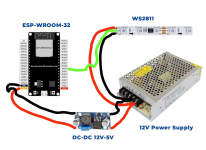
i was ready to order a few ESP32-wroom dev boards and play with them when i realized they require 5vdc. When we mentioned 12v earlier, i thought the esp could handle 12v supply. So now he will need to replace his pixels and power supplies, or add a buck converter to each. More expenses. it's never easy.
 
No he would NOT. A 1USD buck converter to supply the ESP with 5v is all that is needed. V- and Data from the ESP to first pixel or null driver to upvoltage the 3.3v GPIO to the 5v needed by the pixels
 
Yeah, thats what i was saying. add a buck to each receiver. Not exactly sure what a null pixel is. I always considered it one that was not assigned to the show.
This is what i was thinking. is it wrong?
1791064492896.png
 
As long as that green wire is less than 20cm, that will work very nicely. If you get unexpected flickering, add a wire from the V- on the ESP to the first pixel (22AWG is fine, twisted pair is even better) and make sure the wires from the PSU to the first pixel are very beefy (16AWG at least).
 
Back
Top